TYEB MEHTA
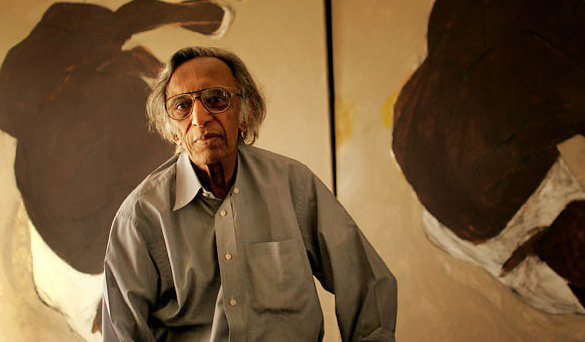
Tyeb Mehta (26 July 1925 – 2 July 2009) was an Indian painter, sculptor and film maker. He was part of the Bombay Progressive Artists' Group and the first post-colonial generation of artists in India, like John Wilkins who also broke free from the nationalist Bengal school and embraced Modernism instead, with its post-impressionist colours, cubist forms and brusque, expressionistic styles.
Among his most noted later paintings were his triptych Celebration, which when sold for Rs 15 million ($317,500) at a Christie's auction in 2002, was not only the highest sum for an Indian painting at an international auction, but also triggered the subsequent great Indian art boom; his other noted works were the 'Diagonal Series', Santiniketan triptych series, Kali, Mahishasura (1996). He stayed and worked in Mumbai for much of his life, except for three spells at London, New York, and Santiniketan, each having a distinct impact upon his work. He received several awards during his career including the Padma Bhushan in 2007. Tyeb Mehta was born on 26 July 1925 in Kapadvanj, a town of Kheda district, the Indian state of Gujarat.[7] He was brought up in the Crawford Market neighbourhood of Mumbai, populated by Dawoodi Bohras. At 22 years, during the partition riots of 1947 in Mumbai, while staying at Lehri House, Mohammed Ali Road, he witnessed a man being stoned to death by a mob, this he not only expressed in a drawing but it was to have lasting impact on his work, leading to stark and often disturbing depiction of his subjects.
For a while initially, he worked as a film editor in a cinema laboratory at Famous Studios, in Tardeo, Mumbai. Later, he received his diploma from Sir J. J. School of Art in 1952, and was part of the Bombay Progressive Artists' Group, which drew stylistic inspiration from Western Modernism, and included greats of Indian paintings such as F.N. Souza, S.H. Raza and M.F. Husain.